

Retail Mystery Shopping: What It Measures and How Multi-Site Brands Use It
Table of Contents:
- What retail mystery shopping is, and what it is for
- The eight things a retail mystery shop measures
- Where multi-site consistency actually breaks down
- How to turn a mystery shop report into action
- How often should retailers mystery shop?
- Questions retailers ask about mystery shopping
- Where to start?
What retail mystery shopping is, and what it is for
Retail mystery shopping is a research method used to evaluate the quality of customer service and overall in-store customer experience. It involves trained researchers visiting or interacting with a business just like a regular customer, then reporting back on everything from service quality to staff performance and product presentation.
Retail mystery shopping aims to identify where the customer journey works, where it breaks down and what needs to change. It shows retailers what customers actually experience, helping them close the gap between brand standards and store-level delivery.
Definition: Retail mystery shopping
Retail mystery shopping is a research method where trained researchers visit your stores as ordinary customers, following an agreed scenario, and report on what they experienced. It measures service quality, product knowledge, store standards and compliance from the customer’s side of the counter. It is sometimes called secret shopping or a CX review.
For multi-site brands, retail mystery shopping provides a consistent view of delivery across locations, without relying solely on management reports or customer complaints.
Importantly, findings should be prioritised and acted on within the next four weeks to ensure that insight is transformed into meaningful change. This involves agreeing on priorities, implementing fixes, and monitoring to ensure that new processes are upheld.
- Retail mystery shopping sends trained researchers into your stores as ordinary customers and then reports on what they find.
- It measures the gap between your brand standards on paper and what happens at the till.
- Findings should be prioritised and acted on within the following four weeks, while there’s still time to turn insight into meaningful change in stores.
The eight things a retail mystery shop measures
A well-designed retail mystery shop measures the key moments that shape customer experience, from the first impression to the final interaction at the till.
| What we measure | What it tells you | Typical failure it surfaces |
| Welcome and acknowledgement | Whether customers are noticed within a reasonable time of entering | Staff at the till, or facing away, on quieter weekday afternoons |
| Needs discovery | Whether staff ask questions before recommending, or jump straight to a product | Product-led selling that closes off the sale the customer actually wanted |
| Product knowledge | Whether staff can explain differences between options with confidence | Knowledge that varies sharply between long-serving and newer staff |
| Handling objections and hesitation | Whether an unsure customer gets helped or gets left | Nobody offers a next step, so the customer leaves to “have a think” |
| Store standards and presentation | Whether stock levels, signage, pricing clarity and cleanliness match the brand | Promotional signage still up after the promotion has ended |
| Till and checkout experience | Whether queue time, payment and any add-on conversation feel smooth | Loyalty or warranty prompts either skipped entirely or delivered as a script |
| Compliance and age-restricted sales | Whether legal and policy requirements are followed every time, not most times | Inconsistent ID challenges, which carry real regulatory risk |
| Close and next step | Whether the customer leaves with a reason and a route to come back | No contact captured, no follow up, no reason to return |
Multi-site operators often require both a Compliance programme and a CX programme, which are scored differently. While Compliance is usually binary: was ID requested, yes or no? Was the required process followed, yes or no? CX is qualitative and scored on a scale that reflects the quality of the interaction, not just whether a step occurred.
Channel coverage is also important, as much of retail takes place outside of a store setting. At insight6, we measure the same brand standards across in-person, telephone, online and video interactions, wherever customers meet your brand.
Where multi-site consistency actually breaks down
Where variation occurs across stores, it often indicates that standards are failing to translate into a consistent customer experience.
Frequently, there is a gap between what a dashboard shows and what a customer actually feels. Example failings include head office standards that never made it into training, peak-time pressure overriding process, or the strongest store setting an average that hides the weakest.
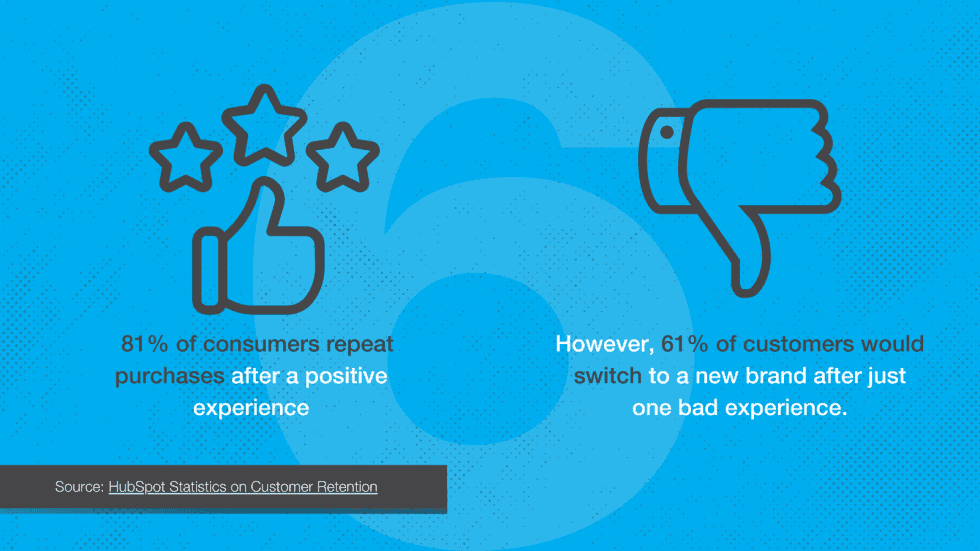
Furthermore, complaint volumes can provide a false sense of customer satisfaction. Research by insight6 indicates that only 1 in 26 unhappy customers formally complain, meaning most unhappy customers leave without telling you what went wrong. A low complaint count is therefore an unreliable proxy for store health.
Independent family retailer Sussex Beds operates 15 branches across Sussex and works with insight6 on mystery shopping, training, and ongoing feedback capture. Initially, the instant insight platform was used to collect feedback from customers solely following a bed delivery. Due to its success, this was soon extended into stores.
What has been particularly useful for Sussex Beds is the ability to filter the data. This allows them to view results separately for each branch, and enables them to spot trends. One customer recently left negative feedback after visiting a showroom to request a quotation. Because the feedback came through in real time, the store manager was able to contact her, address the issue and ultimately retain the order.

How to turn a mystery shop report into action
A mystery shopping report is only useful if something changes as a result. The key is what you do with the findings in the four weeks after you get them.
Follow these steps on how to turn a mystery shop report into action:
- Read the comments before the scores. The score tells you where you are, but the customer’s own words tell you why. That’s the part a store manager can act on.
- Work out whether it’s a one-off or a pattern. One poor visit might just be a bad day. The same issue showing up across six stores points to a training or process problem, and requires a different fix.
- Give each store its own results. Regional averages can hide what’s happening in individual branches. Store-level reporting makes it easier to see where the issue sits and who needs to act.
- Use the results to coach, not discipline. Share results with teams as development. Programmes framed as individual assessment produce defensiveness and gaming, not improvement.
- Re-measure on the same criteria. Change one thing, then shop again against the same questionnaire so the movement is real and comparable.
Checklist: Before you commission a programme for mystery shopping services:
- Decide whether you need CX measurement, compliance testing, or both
- Agree which channels are in scope: in-store, telephone, online, video
- Set the visit pattern across different days and times, not just Saturday mornings
- Confirm you will get store-level reporting, not just a regional roll-up
- Agree who owns the follow-up in each store before the first report arrives
- Check how fast reports come back. insight6 delivers through the client portal within 48 hours
How often should retailers mystery shop?
When mystery shopping, the right frequency is enough to spot a pattern – with more visits when the customer experience is changing.
This distinguishes between a genuine issue and one bad day, and compensates for fluctuations in trading periods, such as peak seasons or new store openings.
For multi-site retailers, this means setting a regular baseline across the estate, then increasing the frequency at the points where consistency is most likely to move.
What’s important is consistency. A mystery shopping programme should give you a baseline you can return to, rather than a series of unrelated visits. This makes it much easier to see whether performance is actually moving and whether the changes you’ve made are successful.
Questions retailers ask about mystery shopping
Retail mystery shopping measures the customer-facing parts of a store visit. This includes welcome, needs discovery, product knowledge, objection handling, store standards, the checkout experience, compliance and whether the customer left with a next step. It is scored against your own brand standards rather than a generic template. The output is a store-level picture of what customers actually experience.
During a mystery shop, a trained researcher visits your store as an ordinary customer, follows an agreed-upon scenario, and then completes a questionnaire based on your standards. The report includes both scores and the shopper’s own words. insight6 delivers feedback through a client portal within 48 hours of the visit.
The difference between mystery shopping and a store audit is that a store audit is usually announced, whereas mystery shopping is carried out covertly. A store audit looks at process, stock and compliance from the business’s side. Mystery shopping examines the experience from the customer’s perspective. Multi-site retailers often run both because they answer different questions.
Mystery shopping can cover every touchpoint where customers meet your brand. Retail is rarely in-store-only, so a programme can test telephone enquiries, web enquiries, live chat, and click-and-collect alongside store visits. insight6 covers in-person, telephone, online and video channels.
Compliance testing is binary: the requirement was met, or it was not, as with age-restricted sales and ID challenges. CX measurement is scored on a scale and covers quality of service. Each requires a different questionnaire design and reporting approach, which is why it is worth deciding upfront which you need.
insight6 delivers all feedback through the client portal within 48 hours of the visit being completed, so store managers can act while the visit is still recent.
Where to start?
Start by identifying the key moments that shape the customer experience for your brand, from the welcome they receive in-store, through to the check-out experience and aftercare. Pinpointing the most important touchpoints will allow you to understand what customers are actually experiencing and where the gaps are.
From there, use the findings to prioritise what needs attention, give the right people ownership and check that the changes made are actually improving the experience.
Key takeaways:
– Retail mystery shopping measures the gap between your brand standards on paper and what happens at the till.
– The areas that should be scored cover service, knowledge, standards, compliance and the close.
– Look at each store, not just the overall result. The differences between branches will show you where the experience is working well and where teams may need more support.
– Complaint volumes are not a reliable CX marker. Research suggests only 1 in 26 unhappy customers complain. The others simply leave unheard.
insight6 work closely with businesses to design, deliver and manage programmes that drive results and transform businesses.
Need help looking at your current measurement approach? Book a 30-minute CX Consultation to talk through what you’re checking, how often you’re checking it and whether the results are reaching the people who can act on them.
For more information, download our CX Business Pack.
Like what you’ve read? Sign up for the insight6 newsletter to stay ahead of the competition with the latest insights and strategies to enhance your customer experience.

0 Comments