

Summer Holidays in the UK: Why the Best Destinations Win Repeat Bookings
Why Summer Sorts the Brilliant from the Average
For many UK hospitality and leisure businesses, summer is the season that determines the success of the entire year. Holiday parks, family hotels, coastal resorts, visitor attractions, and destination restaurants often generate a significant proportion of their annual revenue between June and September.
The challenge lies in changing consumer expectations. With many families facing the cost-of-living squeeze, guests are spending more carefully, researching more thoroughly and expecting greater value from their budget.
The result is a widening gap between destinations that consistently secure repeat bookings and those forced to replace departing guests with costly new customer acquisition each season.
The destinations outperforming their competitors in 2026 rarely do so on price alone. Instead, they excel at delivering a seamless summer holiday destination customer experience from first enquiry through to departure.
Often, it is the small operational moments – a prompt booking response, a smooth check-in, efficient breakfast service or genuine goodbye – that determine whether guests return.
In this article, we’ll explore:
- The State of UK Hospitality in 2026
- The five moments that determine whether a guest rebooks
- The most common UK destination failures
- A 5-step audit framework
- Case studies from successful operators, Bluestone and Hertfordshire Zoo
- The questions most commonly asked by hospitality leaders
- Your Summer Holiday Experience Is Your Year-Round Marketing
Definition: Summer Destination Customer Experience
The cumulative impression a guest forms across every interaction with a UK holiday destination during peak season, from first enquiry through to post-stay follow-up. It includes digital touchpoints (booking site, email, chat), human touchpoints (phone, arrival, in-stay service, departure) and emotional touchpoints (feeling welcomed, remembered, valued). It directly drives repeat bookings, online reviews, and average spend per guest.
The State of UK Hospitality in 2026
Why Guest Experience Is Now the UK Battleground
UK hospitality businesses are operating in a challenging trading environment. Many households continue to feel the effects of higher living costs, meaning discretionary spending remains under pressure.
At the same time, according to the most recent UK Hospitality Christie & Co Benchmarking Report, operating costs have surged to a record high of 55.2% of annual turnover before rent. Operators are dealing with rising wage bills, food and beverage inflation, energy costs and ongoing recruitment challenges; the squeeze is being felt on both sides.
While interest in UK breaks remains strong – with consumers continuing to search for staycations, family holidays and short breaks throughout the year – competition has also widened.
UK destinations are no longer just competing with neighbouring holiday parks, hotels or visitor attractions, overseas operators present stiff competition, with all-inclusive packages that UK operators struggle to match.
In a price-sensitive market, experience remains one of the few factors operators can genuinely control. According to the UK Customer Satisfaction Index (UKCSI), over a quarter of customers say that value, best price and quality have become more important to them in the last 12 months – with 35.6% of customers preferring excellent service, even if it costs more.
UK holiday customer experience has become an important differentiator. Today’s travellers expect smooth booking journeys, friendly service, clean facilities, reliable food and beverage and fast resolution when issues arise. For many hospitality businesses, improving the summer holiday customer experience is one of the most effective ways to protect revenue and encourage repeat visits.
The Five Moments That Decide Whether a Guest Rebooks
Most repeat bookings are won or lost in a handful of operational moments – here are the five that commonly determine whether a guest decides to rebook:
1. The booking enquiry – The speed, warmth and quality of the first response often sets expectations for the entire stay. A tailored and personalised reply versus an automated response can make all the difference.
2. The arrival – The first 15 minutes on site shape a guest’s initial impression. Clear signage, an efficient check-in and a warm welcome can quickly build confidence and put guests at ease.
3. The first 24 hours – When issues arise, the important factor is how it’s handled. A maintenance issue or a problem with a restaurant booking can become an opportunity to impress when resolved quickly and professionally.
4. The departure – The final interaction is often the most memorable. A rushed checkout and impersonal goodbye leaves a very different impression to a genuine thank-you and invitation to return.
5. The post-stay window – The 30 days after departure are critical for repeat bookings. A timely thank-you message, review request and future booking offer maintains a positive experience.
Together, these moments define the summer holiday hospitality CX guests remember, share, review and want to repeat the following year.
The Most Common UK Destination Failures (And How to Fix Them)
Where UK Destinations Lose Repeat Bookings
Most UK destinations lose repeat bookings at five predictable moments. Here’s where, and what to do about it.
Generic booking responses – impersonal auto-replies and delayed callbacks can result in customers looking elsewhere.
Arrival friction – long check-in queues, unclear signage and a lack of visible staff can quickly undermine the guest experience.
Inconsistency across days and shifts – a guest experience from one team can be totally different from another – for example, a brilliant lunch service from one team followed by an indifferent dinner experience from another.
Silent recovery – solving a problem without acknowledging the inconvenience caused. For example, when a room isn’t ready, or a restaurant booking is unavailable.
A lack of post-stay contact – poor communication post visit results in missed opportunities to gather feedback, encourage reviews or secure future bookings.
Improving the summer holiday customer experience starts with identifying and fixing these recurring points of friction.
Practical Fixes and Quick Wins
| Moment in the guest journey | What guests want | Common failure | Quick fix |
| Booking Enquiry | Fast, named, friendly response with the dates confirmed | Generic auto-reply, slow callback during peak | 4-hour SLA, personalised template by name and date |
| Arrival | Clear signage, warm welcome, no queue | Long check-in, no visible host, missed name | One named arrival lead per shift, consistent welcome conversation |
| First 24 Hours | Reassurance that something small can be fixed quickly | Silent recovery, hoping the guest does not mention it | Informal 24-hour check-in by duty manager |
| Departure | Genuine goodbye, accurate bill, quick exit | Transactional checkout, no acknowledgement of the stay | Named goodbye, mention something specific from the stay |
| Post 30 Days | Personal thank-you, review request, a reason to come back | No contact at all, or generic newsletter only | 48-hour personalised thank-you, review nudge at day 7, rebook offer at day 21 |
A 5-Step Framework for Auditing Your Summer Destination Customer Experience
To audit your summer holiday destination customer experience, follow these five steps:
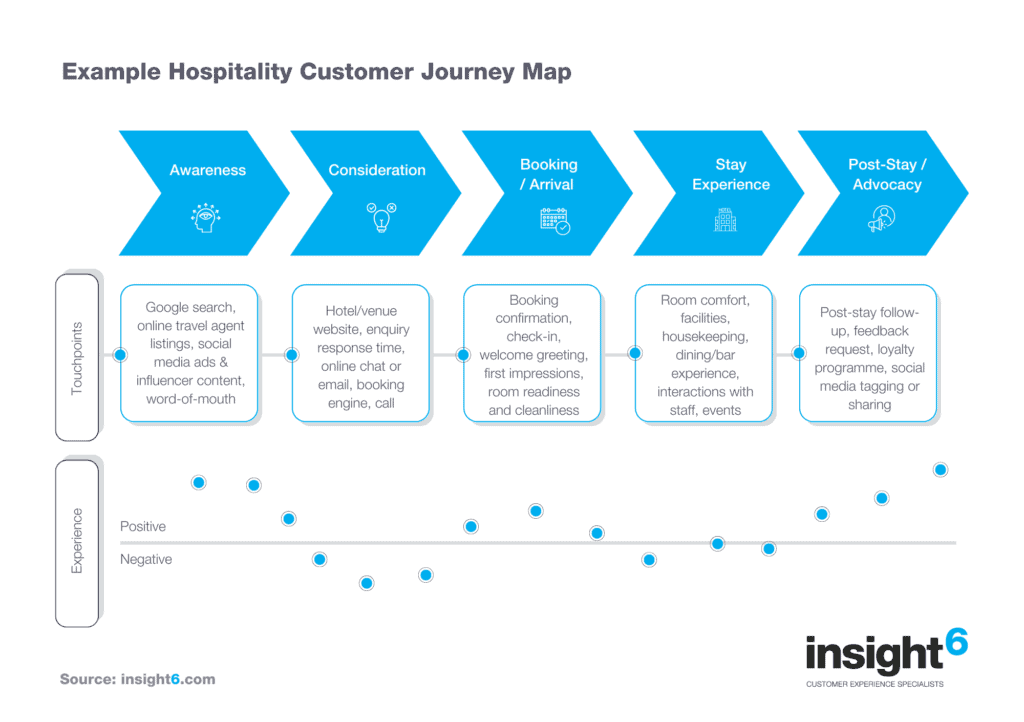
1. Map the guest journey end to end
Start with full applicant journey-style mapping for guests, from first awareness (search ads, OTA listings, recommendations) through to the 30-day post-stay window. This reveals every touchpoint and the team that owns it.
2. Mystery-shop the five moments
Test the experience as a guest would: booking, arrival, in-stay, departure and post-stay. Benchmark performance against at least two competitor destinations. This is where insight6’s mystery shopping programme helps build a consistent data picture across the uk summer holiday customer experience journey.
3. Train front-line staff on warmth, not just compliance
Reception, F&B, housekeeping and activity teams all shape perception. Training should focus on how guests are welcomed, supported when things go wrong, and said goodbye to – the key moments that most influence reviews.
4. Measure guest sentiment at every stage
Do not rely solely on end-of-stay surveys. Capture feedback at booking, arrival, mid-stay and post-stay to understand how the customer experience evolves in real time.
5. Close the loop weekly
Bring duty managers, marketing and senior leadership together each week to review findings. Assign ownership, agree fixes and track progress to ensure change.
Case Study Spotlight: Bluestone National Park Resort
The challenge:
Bluestone, a Welsh holiday park resort in Pembrokeshire, wanted to track its guests’ journey and measure their experience at critical points during their stay. They also wanted a more honest read on employee experience, on the basis that happy teams build better guest experience.
What insight6 did:
insight6 implemented a guest experience tracking system and replaced Bluestone’s annual employee survey with its instant insight platform. Quarterly pulse surveys provided regular employee feedback, enabling more timely action. The resulting information provided actionable recommendations, helping Bluestone strengthen both employee engagement and guest experience.
The result:
Employee participation rates improved from 64% to 85%, enabling better decision-making and a more engaged workforce. Bluestone subsequently became the first business in Wales to receive the insight6 CX Excellence Mark and one of only 15 UK organisations recognised in that way.
Claire Lewis, Head of Guest Experience at Bluestone, said: “Investing in understanding our guest’s experience on a broader level has provided us with invaluable feedback to enhance our day-to-day operation. It ensures we are constantly looking at how we can improve our services and is one reason, we hope, why our guests leave happy, relaxed and want to return. Part of the process means having all your team invested, and when your team is happy, this only enhances your customers’ experience, and vice-versa.”

Case Study Spotlight: Hertfordshire Zoo
The challenge:
Hertfordshire Zoo, a Broxbourne-based visitor attraction voted the number one attraction in Hertfordshire by TripAdvisor, had always taken pride in offering excellent service. As the zoo expanded, leadership wanted a clearer understanding of the visitor experience across multiple touchpoints. The organisation also wanted to strengthen customer service standards among a growing seasonal workforce – embedding a culture of service excellence across every team and interaction.
What insight6 did:
CX Director, Paul Saunders, implemented regular mystery shopping across peak season (April to October) with an additional December visit for year-round consistency. The team conducts monthly phone and online assessments to evaluate the entire customer journey across all channels. They also deliver a comprehensive customer service training programme across every level of the organisation – not only raising service standards but instilling a shared understanding of what excellent customer experience looks like, and how each team member contributes to it.
The result:
Throughout the partnership, analysis shows a marked improvement in service consistency and customer satisfaction. The impact is clear in the numbers:
- Day ticket sales increased by 15%, averaging a 1.25% annual rise
- Total visitor numbers grew by 61%, averaging a 4.5% increase each year
- Membership numbers rose by 820%, an impressive 25% yearly increase

Q&A: Key Questions Answered
A. Summer holiday destination customer experience is the cumulative impression a guest forms across every interaction with a UK holiday destination during peak season, from first booking enquiry through to post-stay follow-up. It includes digital touchpoints, human touchpoints and emotional touchpoints. In UK hospitality, it is the single biggest driver of repeat bookings, review scores and average spend per head.
A. UK destinations cannot consistently compete with overseas all-inclusives on raw price. They can compete on warmth, consistency, recovery and the small moments that make a guest feel personally looked after. Those moments are what guests describe in five-star reviews and remember when choosing where to go on their next summer holiday.
A. The most useful metrics are response-time SLAs on enquiries, NPS or CSAT captured at booking, arrival, mid-stay and post-stay, mystery-shop scores against competitor destinations, and review sentiment trends on Google and TripAdvisor. The key is measuring at each stage, not only at the end of the stay.
A. A 4-hour booking-enquiry SLA, personalised acknowledgements by name and date, a consistent arrival welcome, a 24-hour informal check-in during the stay, and a 48-hour post-stay personal email. Most of these can be in place within a single peak season.
A. Operational changes (response times, arrival flow, post-stay emails) show up in review scores and rebook rates within one season. Cultural changes (training, journey mapping outcomes) typically take two seasons to fully embed across all teams and shifts.
A. Yes, and it is the most efficient way to surface the gap between what your team thinks the guest experience is and what it actually is. The strongest programmes mystery-shop across booking, arrival, in-stay and post-stay, not only the obvious in-person moments.
Conclusion: Your Summer Holiday Experience Is Your Year-Round Marketing
What happens during the summer months has a knock-on effect, feeding directly into next year’s enquiry and booking pipeline.
More often than not, an exceptional, seamless customer experience is what separates destinations that win repeat bookings from those that scramble for new ones every year.
Most breakdowns occur in the same five places: booking enquiry, arrival, the first 24 hours, departure and post-stay. These are the pressure points where the uk holiday customer experience is either reinforced or undermined.
A structured 5-step audit framework takes businesses from relying on instinct to making decisions based on evidence. Better responses, smoother arrivals and more effective follow-up not only improve the guest experience today, but also influence the reviews, recommendations and repeat bookings that drive future growth.
This article has focused on the operational discipline behind delivering great hospitality CX in peak season. Our companion piece explores what hospitality experience actually means, and how to build the foundations that make consistency possible.
Contact us today for a free consultation with your local insight6 director and learn how we can help transform your customer interactions and drive business growth.
Like what you’ve read? Sign up for the insight6 newsletter to stay ahead of the competition with the latest insights and strategies to enhance your customer experience.



0 Comments